Sunday, October 31, 2010

Getting Out the Vote for Life

Have you voted yet?


I voted by absentee ballot a few weeks ago knowing I would be out of town on election day.

If you are interested in supporting pro-life issues consider supporting Americans United for Life.

I voted for life - all life is precious!

Wednesday, August 18, 2010

DownsEd Conference in Atlanta


The Down Syndrome Association of Atlanta is hosting a DownsEd conference next month - September 9 - 11. It is not to late to register!

Here is the brochure and registration info.

DownsEd has been instrumental in bringing up-to-date research into Down syndrome to professionals and families in a easily understood format. These events are so informative and inspirational - especially for homeschooling families. Do take advantage of this opportunity if you can!

Wednesday, April 21, 2010

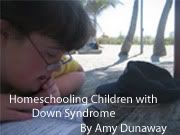
My New E-book - Homeschooling Children with Down Syndrome


A compilation of years of research on how children with Down syndrome learn and part of a much larger project.

Just click on the button to view for free. I would love to hear feedback from you!

Tuesday, April 13, 2010

Homeschooling and Down Syndrome - The Reluctant (???) Learner

Part Two - The Child

In trying to discern what difficulties there might be in the learning environment which might result in reluctance or resistance, I always ask myself or might ask you the following questions:

Health

Are they feeling well? A child who is not feeling well is not receptive to learning. A child who does not get sufficient sleep will not be receptive to learning.

Are their eyes and ears healthy? Vision and hearing problems are common with Down syndrome and a great impediment to learning. Attention to these potential problems is needed with annual (minimum) physical exams.

Motivation

Is motivation a factor? Children with Down syndrome are known to have motivational issues when compared to typically developing children of the same age. From the time that our children with Down syndrome are born, they work hard to learn the skills they need – harder and longer than typically developing children. They are familiar with failure and need to be supported in learning with errorless teaching/learning to feel successful.

Is the child bored? Young learners with Down syndrome thrive on material given at a fast pace in an engaging manner. Keep it FUN!

Is the work provided close to the child’s developmental level? Working closely to his/her developmental level will make her feel successful and involved...and motivate her to come back for more!

Attention

Are attention deficits a contributing factor? Attention deficits are common in young learners with Ds. Incrementally increasing time and attention to task is worth the time and effort inside and outside of formal schooling is well worth the time and effort.

Is it hard for the child to sit still for learning? Alternate seat work with fine and gross motor activities. Keep any seat work meaningful. Lessons should be fairly short and fast paced. Keep the fun factor high!

Combining physical movement with learning can be quite helpful and enjoyable.
A friend of mine did “ball school” when her son with Down syndrome was young. He practiced sight word reading while bouncing a ball. This markedly increased his ability to learn new words.

Learning Profile

Children with Down syndrome have a known profile of strengths and weaknesses to consider in the homeschooling environment.

Am I teaching to my child’s learning strengths? Children with Down syndrome are primarily visual learners. Therefore, material presented should be accompanied by a visual aid.

What about processing deficits? Children with Down syndrome frequently have auditory processing difficulties. This makes learning by listening difficult. Again, visual cues are of the utmost importance.

Am I using language the child understands? As parents, we have a greater understanding of the words our children understand. We know they understand far more than they can express. New vocabulary should be specifically taught and clearly defined.

The Learning Environment

Are their any distractions? Is the house free from noises from the television, radio or adults or other children talking? Children with Down syndrome are easily distracted by noise and even visual stimuli.

The Learning Table

Learning does not necessarily happen at a table. In fact, much does not but I will refer to lesson time as work done at the table.

Is the work meaningful? Am I building on what the child knows – scaffolding new skills on top of what has been consolidated?

Is what they are working on to easy or to hard? Early learners with Down syndrome should be working close to where they are functioning on the developmental scale you are using – again, building on skills they already have.

Am I breaking down the task/concept in to smaller bits so that the child can understand the task/concept? With many concepts/skills, we have had to break them down into smaller steps and spend extra time on them. Breaking down skills/concepts gives meaning to the task as each step is mastered.

Am I providing enough repetition for the mastery of skills and concepts? Frequent input and plenty of review are the keys to consolidation of learning.

Am I giving them enough practice at new skills and concepts? Often a wide variety of materials, rotated throughout the week to reinforce new skills/concepts are necessary to consolidate learning.

Am I taking into consideration the child’s interests? In bringing the child’s interests into the learning environment, the most mundane of tasks takes on interest.
Is the curriculum a good fit? Concept oriented materials with a hands-on, visual approach works best for the early learner with Down syndrome.

Challenging Behaviors

Are behaviors getting in the way of learning? Often times, challenging or inappropriate behaviors are clues that you need to switch gears. Change the subject. Change the venue. Go for a walk but keep the child engaged!

Normal childhood naughtiness or the avoidance behaviors (cute but socially inappropriate behaviors) common to children with Down syndrome can disrupt the learning environment. Think about positive behavioural approaches vs. the more common parenting approaches which include punishments that are ineffective.

Sometimes behavior challenges are of a more serious nature. If so, those behaviors can be the greatest obstacle to learning a child with Down syndrome faces. If necessary, seek professional support.

Previous Learning Experiences

What previous learning experiences has the child had? Has the child been removed from the system recently? Was their previous learning environment traumatic? You wouldn’t believe the stories I’ve heard from families who have removed their child from the public school system.

The general rule of thumb for homeschooling families is that the child will need a month for every year in the system or adjust (some say recover) to homeschooling. I think it is safe to say a child with cognitive impairments will take longer.


In Closing

What seems to be reluctance or resistance on the part of the learner with Down syndrome can be the result of many complex issues – none of which are insurmountable. Persistence on you part will pay huge dividends!

Part One

Unbelievable

A Florida abortion provider loses his license for killing the wrong twin. After the healthy twin is killed, the baby boy with Down syndrome is terminated.

Tragic

Friday, March 19, 2010

Giveaways at Barbara Frank Online

My friend Barbara, over at Barbara Frank Online, is having a series of giveaways. Barbara and her husband have just republished a book called An 1890 Kindergarten Story Curriculum - The original author, a teacher, organized it into a school-year’s worth (September to June) of stories and object lessons for young children.

Barbara is a fellow homeschooling mom and author who also has a child with Down syndrome.

Ending tonight is a great book giveaway, How to Win Friends and Influence People by Dale Carnegie. Leave her a comment to win!

The next giveaway is How to Stop Worrying and Start Living by Dale Carnegie - another great read!

Please stop by Barbara's blog to enter!

Oh, and sign up for her free monthly newsletter while you're there!

Saturday, March 13, 2010

Homeschooling and Down Syndrome - The Reluctant (??) Learner

Part One - The Homeschooling Parent

Children with Down syndrome (Ds) aren’t really reluctant learners but it may seem that way - especially in the early years of their lives. What may appear to be reluctance or resistance is just the way they try to deal with the complexities of life with Ds and the obstacles they face in learning.

Over the years I've had quite a few questions on this issue. I would like to share a few tricks of the trade. Little things that have helped me that might help you. Some are quite obvious but some thought given to the obvious may garner some new insights as to the importance of what is obvious and how it plays into the homeschooling environment.

Children First
Children with Ds are children first. Children are fun and like to have fun. They are silly and playful so why not play along! My experience with a child with Ds is that there is more fun with the extra chromosome! The learning environment should be filled with interesting and engaging materials that help make learning FUN!

The Parent
As homeschooling parents, we may be overwhelmed by the obstacles to learning our children with Ds face. I’m here to tell you its all about baby steps. – your own and the child’s. Homeschooling a child with Ds is not that hard – it just takes time and effort to learn how the child learns, what obstacles they face and then implement what you have learned into the child’s learning environment. You will learn together to make your home the best learning environment for your child!

Educate Yourself
Be educated and informed. My archives hold a great deal of information on homeschooling and Down syndrome. The sidebar to the right has many useful links. The Riverbend Down Syndrome Support website is full of research related to how children with Down syndrome learn and also quite a bit of information on homeschooling children with Ds.

Commitment
We all go through a research phase when considering homeschooling our children with Ds. It is usually a time filled with anxiety – very normal! We wonder if we are capable of this huge responsibility. You are! Once the decision is made to choose the homeschooling option, commit yourself fully to it. Our children will sense if we are just experimenting and not fully committed.

Our Approach
Are we approaching homeschooling our child based on their needs? When I was in the research phase, I feel in love with a literature based method of homeschooling. Soon I found out that approach would not be best for Reagan. She does not learn well from listening due to auditory processing issues.

So I switched my thinking and approach to best suit her learning needs. As you know, children with Ds are visual learners. All information given verbally should be paired with a visual – gesture, sign, flashcards, picture cues, the written word etc.

Our Attitude
Our attitude is so important to the learning environment. Our attitudes are contagious! If we approach our day and school hours with a positive outlook and enthusiasm our children will too!

I am by nature a quiet, reserved person. Though I do tend to look at life with a positive outlook, Reagan demands more of me. She has turned me into a rather loud and boisterous cheerleader! We feed off of each other in our excitement and love for learning.

The Parent – Child Relationship
A warm, loving relationship between the parent and child is essential in the homeschooling environment. Nurture this and many of your battles are won! Children with Ds tend to be very sensitive to the feelings of others. Reagan is no different. She wants to please me

Latent Gifts?
Homeschooling moms might discover a few latent gifts! Homeschooling may develop some underdeveloped gifts waiting to blossom!

Patience
Doesn't every parent pray for more patience? Homeschooling a child with Ds requires patience. Learning often takes longer and requires many more learning trials than with typically developing children. Just remember that as you tire of teaching a skill/concept they are just beginning to get it. The joy that follows when a new skill is accomplished or a new concept is consolidated is glorious!

Creativity
Don’t let your perceived lack of creativity stop you from considering homeschooling! I don’t consider myself the creative type but am surprised over and over again by what is delivered to me (from above) that which is needed to get a concept across! New avenues of delivering more abstract material appear with perfect timing.

Part Two

Thursday, March 11, 2010

Homeschooling and Down Syndrome - Routines

Remember my post on the groove? A groove is simply defined as a set pattern or routine in one’s actions or thoughts. Routine and structure are important to young learners with Down syndrome. The groove allows them greater freedom and independence within the known routines.

Individuals with Down syndrome thrive with a set routine.

Routine and structure are also important to the homeschooling household. Without a routine in our home, little would get done.

Routines are important to typically developing children too!

Routines are important for all of us!

A few suggestions for families homeschooling a child with Down syndrome regarding routines and motivating the child to work within the routine:

Develop a routine and stick to it.
It is important that your child knows what to expect every day. Soon you’ll find that your child will remind you what is left to be done.

Devote yourself to the routine.
Most of the distractions to our day came from the telephone. Train yourself to avoid those distractions until what you need to accomplish as far as school is complete.

Make a visual for the child to refer to as the day progresses.
Initially, I would just use a daily schedule. As the child understand the rhythm of the day, move on to weekly and monthly schedules.

Prepare the child well ahead of time of any changes.
Again, the groove. Changes in routine may cause anxiety in the child with Down syndrome. There will much less anxiety if any changes in the daily routine are talked about and placed in the weekly schedule.

School is not a choice.
Reagan has never known that she has a choice as far as doing her school work. It is something that happens every day. She does have choices about the less important things in her life but reading, writing and arithmetic are to be done daily.

Plan ahead.
Every Sunday I take the time to plan out our week. I plan and I gather materials so that when it comes time to start our day, I’m not running all over trying to find things while my child loses interest.

Speaking of planning
Plan all those necessary errands and physical/dental/therapy appointments after school hours.

Make fun a priority
The daily routine should consist of things the child enjoys inside the work day. Choose the right high interest materials to make learning fun.

Learning should be meaningful.
To keep the child engaged, learning should target the child's interests and build on what they know. New skills and concepts should be broken down into smaller steps to build on. As the skills/concepts are practiced and consolidated, add another step.

Consider rewards
I know you’re thinking food but I am not! Sincere, appropriate praise will be genuinely appreciated and will go far in keeping with the flow of the day and the child's willingness to participate.

Use that wonderful parent – child relationship as a reward for you both. How about a little cuddle time on the couch with mom and a good book? Our visual learners all love a little computer time or a DVD for a good school day and a job well done.

Speaking of rewards.
Sprinkle rewards throughout the day as necessary. More frequent rewards may increase motivation to stay with the scheduled day.

Tuesday, March 9, 2010

The Pace

I have always loved an essay by Dennis McGuire, Ph.D, of the Adult Down Syndrome Center of Lutheran General Hospital in Park Ridge, Illinois called The Pace. One of the most valuable lessons Reagan (15 y.o. with Down syndrome) has taught me is to slow down and delight in the little things in life. Moving with her, at her pace, brings many new discoveries and joys. She sees the world and delights in it like it is new every day. What a gift!

While Reagan does not have obsessional slowness, an obsessive-compulsive disorder found in some people with cognitive impairments, she does move at her own pace. A pace where she can take in, process and react to her environment.

It is a slower pace. A pace where beauty flows and God is allowed in every moment. In fact, it is about living in the moment. There is a rhythm to it that I had not known before. Its almost magical.

Interestingly enough, I do not talk to her at a slower rate. We do our school work at a very rapid pace so that she does not get bored. Boring is another "B" word (along with brush and bath) around here. If Reagan senses a "B" word, watch out for avoidance behaviors and mild irritation!

Yes, I have know frustration with the pace...and I ask God to forgive me for being so selfish and small. The pace has blessed me abundantly and I am grateful.

So, we pace our days with her - planning a little more time during activities of daily living and outings to allow for her pace. My life is better for it. It lets us see the little things that might otherwise pass us by. Life it so much less stressful at Reagan's pace. The pressure is off and we are free to enjoy.

The pace - one of the many blessings of having a child with Down syndrome.